
Techo-Bloc General Contractor in Mission Viejo: A Homeowner’s Guide
Techo-Bloc sells its pavers as a lifetime product, and they can be – but the company’s own installation manual runs roughly 40 pages. A Techo-Bloc paver is only worth the premium when the contractor under it follows the brand’s base and jointing specs to the letter. Most don’t. If your contractor can’t tell you the specified polymeric sand joint width off the top of their head, the money you paid for that paver gets buried in the dirt.
This guide is about holding your Mission Viejo contractor to the standard Techo-Bloc actually requires – the base depth, the jointing sand, the edge restraint, and the written contract that ties all of it to your money. If you’d rather have someone check the details on your behalf, call (833) 734-2429.
Why Techo-Bloc Costs More – and When That Premium Pays Off in Mission Viejo
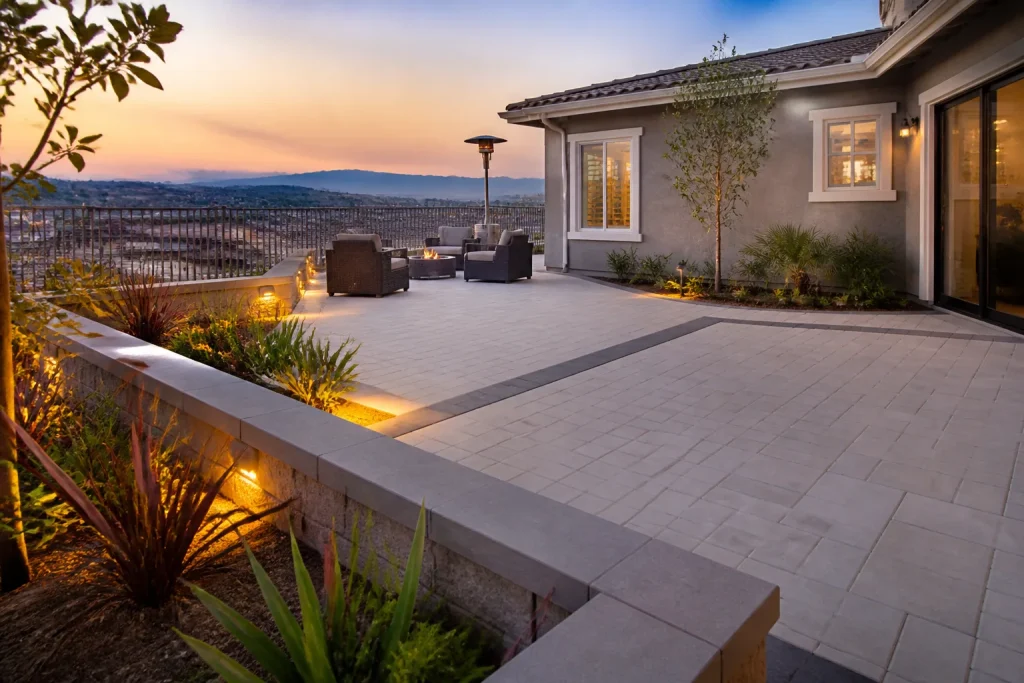
Techo-Bloc sits in the same premium tier as Belgard, and the premium is real: plan on the paver surface alone running $8 to $14 per square foot in this market, before base prep, sand, and labor. The difference you’re paying for is density, tighter dimensional tolerances, and a face mix engineered to hold color. That matters in Mission Viejo, where a hardscape gets baked on south-facing slopes and soaked during winter storms off the Saddleback foothills.
Here’s the honest part. The premium is worth it in three cases:
- Driveways and heavy traffic paths. Higher compressive strength and tighter joints hold up under vehicle loads.
- Sun-exposed patios where you want the color to stay put rather than fade into a chalky version of itself within a few seasons.
- Visible hardscape – the front walk, the pool deck, the fireplace surround – where dimensional consistency reads as “installed” instead of “assembled.”
Where it isn’t worth it: a back-corner utility pad nobody looks at, or any job where the installer skips the base prep. A premium paver on a shallow, poorly compacted base will fail faster than a budget paver set correctly. The paver is the visible product. The base is what makes it last.
The Base Depth Question: What Techo-Bloc Specs for Southern California Soil
Techo-Bloc calls for a compacted crushed-aggregate base, placed in lifts and mechanically vibrated between passes – not dumped in one pile and raked flat. In Southern California’s expansive clay soils, that lifts-and-compaction discipline is the whole game. Skip a lift, and you get settling, heaving, and joints that open up a season later.
For a residential patio or walkway in Mission Viejo, expect a base in the neighborhood of 4 to 6 inches compacted. For a driveway, plan on 6 to 8 inches, sometimes deeper where the subgrade is soft or drains poorly. The exact number depends on native soil and expected load, which is why a good contractor probes the subgrade before quoting.
How to verify it before you pay:
- Ask for the base depth in writing, per square foot of the job, not a rounded total.
- Ask how many lifts they’ll place and how each is compacted.
- Ask for photographic proof of compaction before the bedding layer goes down.
- Ask what happens if they hit soft subgrade mid-job – and get the answer in the contract before work starts.
We routinely see patios installed over a single un-lifted base that looked fine at handover and settled 3/8 of an inch by the following spring. That’s the failure the spec exists to prevent.
The Polymeric Sand Rule: Why Generic Jointing Sand Voids the Warranty
Techo-Bloc specifies its own polymeric sand for jointing. It’s a proprietary blend engineered to lock the joints, resist weed growth, and flex with temperature swings. Substituting generic jointing sand or a non-approved polymeric product voids the performance claim Techo-Bloc makes on the finished system – even if the pavers themselves are genuine.
Why it matters here: Mission Viejo’s dry summers and wet winters put joint sand through a hard cycle. Cheap sand washes out, settles, and opens gaps that hold water. Once water gets under the pavers, freeze-thaw isn’t your problem – it’s the clay soil under them swelling and shrinking.
Questions worth asking your contractor before they start:
- Which Techo-Bloc polymeric sand product are you using, by name?
- What joint width is it specified for, and is my paver within that range?
- Will the joints be sealed – and is the sealing included in the written price?
If the answer to the first question is “whatever the supply yard had,” stop there. That’s not a spec, it’s a guess.
Edge Restraint: Driveway vs. Patio – and What the Contract Should Spell Out
Edge restraint is the least glamorous part of a hardscape and the most common source of failure. It’s the border – usually aluminum or spiked plastic – that holds the pavers in place. Miss it, and the pavers creep outward, joints widen, and the whole surface starts to move.
The spec differs by application:
- Driveways: heavy-duty aluminum edge restraint, spiked down into the base, not the bedding layer. Non-negotiable here, because vehicle load pushes pavers outward on every turn.
- Patios and walkways: spiked plastic or aluminum can work, but the spikes need to reach into the compacted base, not sit in the sand cushion.
- Pool decks: restraint plus a proper slope away from the coping, with joints sealed to spec.
Your written contract should name the restraint product, confirm that spike depth is into the compacted base, and state who’s responsible if an edge lifts within the warranty period. If the contract says “edge restraint included” and nothing else, ask for the product name. A vague contract is where surprises hide.
This is the same reasoning we apply to other finishes – KraftMaid or Wellborn cabinetry goes in with documented specs, Cambria counters come with a slab number. Material without spec is just a receipt. If your project is running alongside interior work, our Kitchen Remodeling in Mission Viejo page covers how we structure written scopes there too.
Payment Tied to Inspections, Not Calendar Dates
The single biggest protection you have on a Techo-Bloc install isn’t the brand on the box. It’s when you pay. A well-structured payment schedule ties every dollar to a documented milestone you can see and photograph. Calendar-date payments reward a contractor for simply showing up. Milestone payments reward them for hitting the spec.
A reasonable structure looks like this:
- Mobilization and staking – a modest deposit when materials are delivered and layout is confirmed.
- Base compaction – paid after the base is compacted in lifts and photographed, before bedding sand goes down.
- Bedding layer and paver setting – paid once pavers are set, screeded, and cut to the restraint line.
- Final joint sealing and cleanup – the final payment, held until the joint sand is placed to Techo-Bloc spec, the edge restraint is inspected, and the site is clean.
That final payment is your leverage. Techo-Bloc’s own spec sheet is the checklist you use to release it. If any line fails – base depth not to spec, generic sand in the joints, restraint not spiked deep enough – the money stays in your account until it’s corrected. That’s the moment the premium you paid for the paver actually gets protected.
When to Call a Pro
A small repair – replacing a handful of pavers, re-sanding a single joint line – is a weekend job and we won’t pretend otherwise. A full Techo-Bloc installation is not. The failure modes that cost the most money – base settling, joint washout, edge creep – happen six to eighteen months after handover, and they’re expensive to fix because the whole surface comes back up. That’s the risk you pay a contractor to manage.
If your project needs a general contractor running the hardscape alongside other work, our General Contractor in Mission Viejo page covers how we sequence and scope multi-trade jobs. If a bathroom or patio-adjacent bath is in the plan, Bathroom Remodeling in Mission Viejo walks through the same written-price approach.
Related services in Mission Viejo: Bradford Remodeling Co Mission Viejo home.
The Bottom Line
Techo-Bloc is a premium product that only holds up to its lifetime reputation when the base, joint sand, and edge restraint are installed to the brand’s written spec. That means compacted base in lifts at the correct depth for your application, the specified polymeric sand (no substitutes), edge restraint spiked into the compacted base, and a payment schedule that releases money against inspection milestones – not the calendar. The paver is the easy part. The specs under it are where Mission Viejo homeowners get burned.
If you’re in Mission Viejo and need help, Bradford Remodeling Co Mission Viejo offers free estimates. We put the price, the spec, and the guarantee in writing before a single tool comes out, and every completed job carries our 365-Day Done Right Promise: if the work fails within that window, we come back and correct it at no charge. Call (833) 734-2429 to schedule your free estimate.
Frequently Asked Questions
Plan on roughly $25 to $45 per square foot installed for a residential Techo-Bloc patio in Mission Viejo, with the paver surface alone at $8 to $14 per square foot. The rest is base prep, bedding, polymeric sand, edge restraint, and labor. Driveways run higher because of the deeper base and heavier restraint. Call (833) 734-2429 for an exact quote – estimates are free.
It shouldn’t. A written price, agreed before work begins, is the baseline. The only legitimate change is something the contract anticipated – soft subgrade discovered mid-excavation, for example. If your contractor wants to reprice after the first day for anything other than a documented subgrade issue, that’s a contract problem, not a site problem. Ask for line-item pricing up front and hold them to it.
Typically no permit for a surface-level patio, but additions involving retaining walls over a certain height, structural changes, or work in drainage easements do require review. Requirements vary by parcel, so confirm with the city before work begins. A general contractor who pulls permits and passes inspections will handle that confirmation in writing. Call (833) 734-2429 to talk through your specific project.
A typical Mission Viejo patio in the 300 to 500 square foot range runs three to five working days, weather permitting. Driveways run longer because of the deeper base and curing time. The base lifts and compaction stages take the most time and are where rushing causes a failure a season later. Get the timeline in the written scope and tie payments to inspections, not dates.
Written by the team at Bradford Remodeling Co Mission Viejo.
Need Construction Help?
Call Bradford Remodeling Co Mission Viejo - licensed & insured, here with fast after-hours help in Mission Viejo.
(833) 734-2429