
Emergency General Contractor Near Me: What Mission Viejo Homeowners Should Do First
If you call a contractor before you call your insurance carrier after storm or water damage, you may have already compromised your claim. Most homeowner policies require you to notify the insurer before you authorize repairs, and a signed work order handed to an unsolicited contractor can be read as authorization. The order of your first four calls matters more than the speed of any one of them.
The sequence that protects you is document, notify, mitigate, then scope. Get that right and a bad night stays a bad night instead of a six-month claims fight. If you’d rather not sort through it alone, you can call us at (833) 734-2429 and we’ll walk you through the steps in plain language, no charge.
Why the Order of Your First Calls Matters

Insurance policies are contracts, and contracts care about sequence. Nearly every standard homeowners policy in California includes a duty to notify the insurer of a loss promptly and to protect the property from further damage. Notice first, then protection. Skip the notice and you haven’t broken a rule exactly, but you’ve made the adjuster’s job harder and given the carrier room to question whether the damage you’re claiming is the damage that happened.
Here’s the part most homeowners miss: authorization to repair can be implied. If a contractor knocks on your door the morning after a storm, hands you a one-page work order, and you sign it so the water stops spreading, you may have just authorized permanent repairs before your carrier has inspected anything. The insurer can then argue the scope was set without their input. Even if the contractor does excellent work, the paperwork problem lands on you, not them.
What order actually works:
- Document. Photos and video of everything, before anything gets moved, dried, or torn out. Wide shots of each room, close shots of the damage, and a shot of a tape measure against the water line if there is one.
- Notify your carrier. Open the claim. You don’t have to accept a number yet. You just need a claim number and a date stamp.
- Emergency mitigation. Stop the damage from spreading. This is a separate scope from repair, and we’ll get to why that matters.
- General contractor scope. Only now does a GC put a written scope and price together for the actual rebuild.
In Mission Viejo, the homes most likely to test this sequence are the hillside properties above Lake Mission Viejo and the older tracts where original plumbing and drainage are now decades past their design life. A slope failure or a slab leak at 11 p.m. does not care about your claims process. The process still applies.
What Emergency Mitigation Covers (And What It Doesn’t)
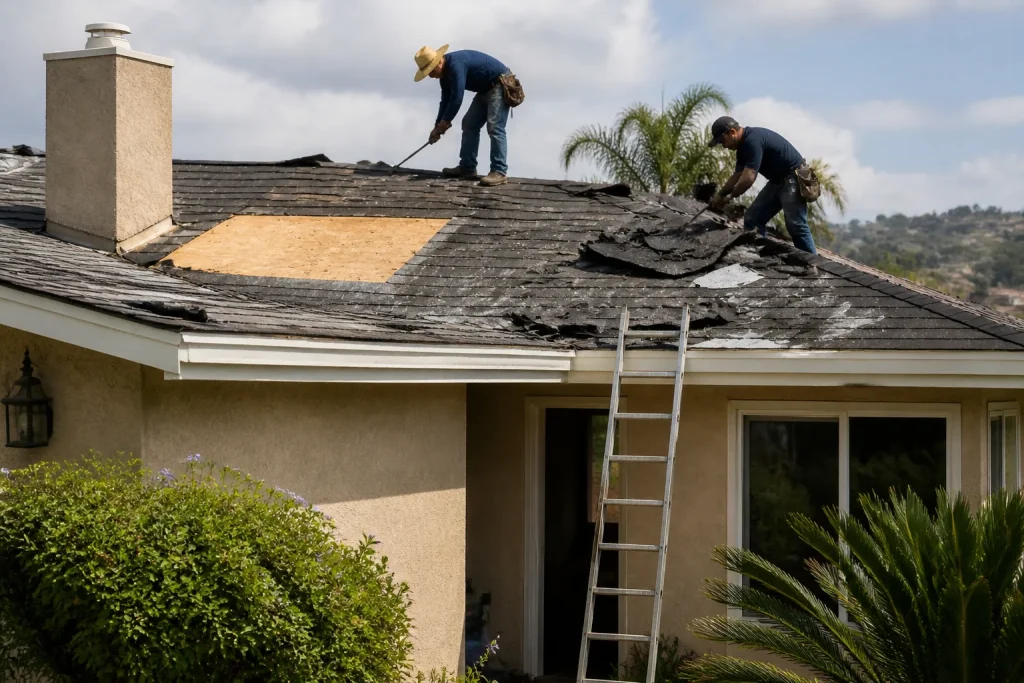
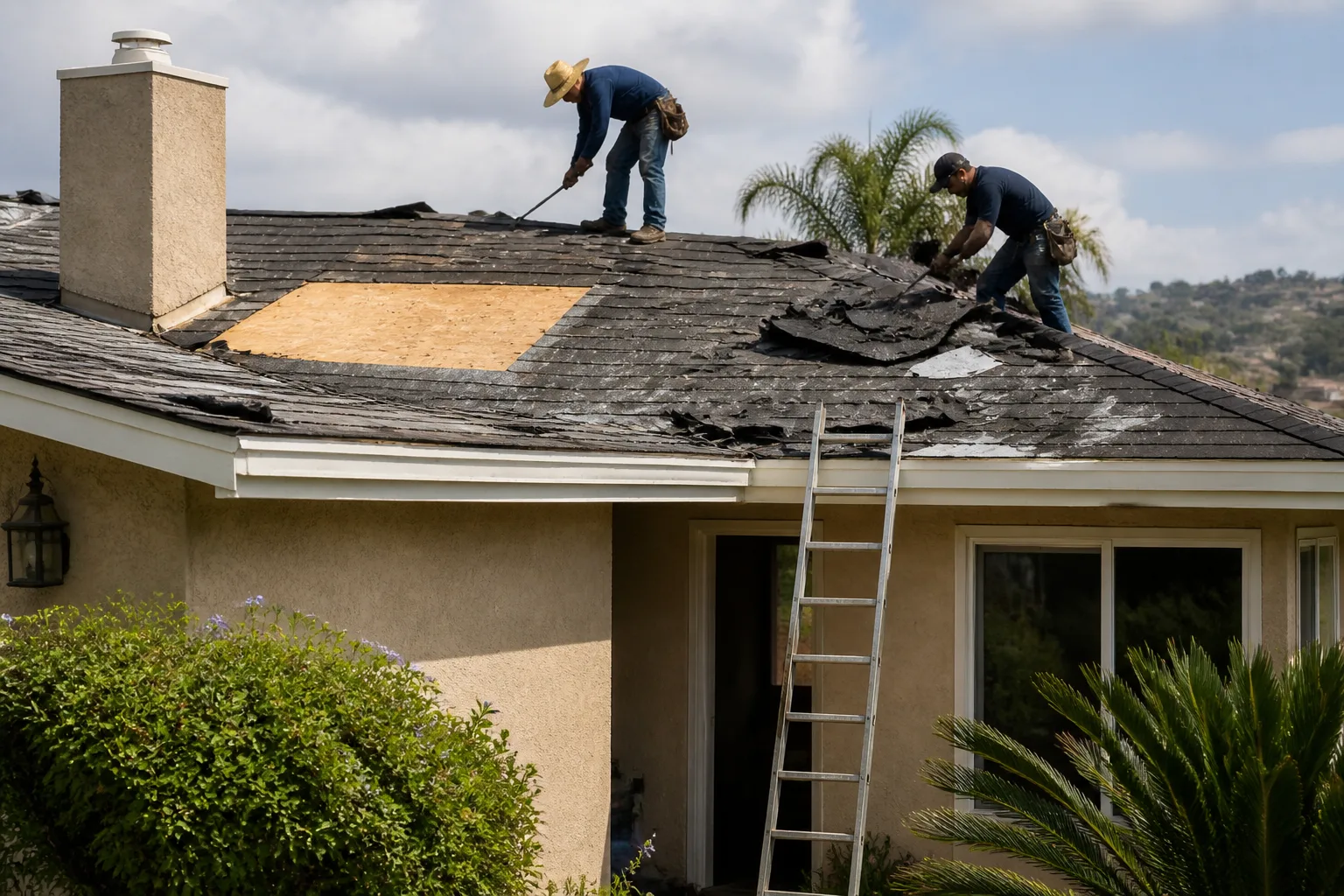
Emergency mitigation is the work that stops active damage: extracting standing water, setting drying equipment, tarping a compromised roof, boarding a broken window, shutting off a failed supply line. It is not the repair. It is triage.
These should be two separate contracts, and this is where homeowners get hurt. A mitigation company that also wants to handle the rebuild has an incentive to define the damage in a way that suits their scope. Worse, some mitigation invoices get written as “emergency services” with open-ended hourly language, and the final bill arrives north of what anyone discussed at the door.
What a mitigation scope should spell out before anyone touches a wet vac:
- A firm price or a hard cap, in writing, before work starts. Not an hourly rate with no ceiling.
- Exactly what equipment goes in and for how long (air movers, dehumidifiers, drying days).
- What gets removed versus what gets dried in place. Cabinets, baseboards, and drywall are the usual arguments.
- Moisture readings documented before and after, with the meter readings written on the invoice.
- A clear statement that this contract covers mitigation only, and that repair is a separate agreement.
Separating the two keeps the rebuild honest. The mitigation crew’s job is to stop the bleeding and hand over documentation. The rebuild scope gets priced on its own merits, after the carrier has seen the loss. When we scope a rebuild in Mission Viejo after a water event, we want the mitigation report in hand first, because the drying log tells us what’s actually wet and what only looks wet.
How to Vet a Contractor Who Shows Up Unsolicited

After any local event, storm, fire, or flood, out-of-area crews arrive within days. Some are legitimate and simply chasing work. Others are predatory, and Orange County sees a predictable pattern. The tell isn’t that they knocked on your door. Plenty of good contractors work neighborhoods after a storm. The tell is in how they handle the paperwork.
Warning signs specific to this area:
- They want to “handle the insurance for you.” A contractor can provide photos and a scope. A contractor cannot negotiate your claim or act as your adjuster. If they offer to deal with the carrier on your behalf and keep you out of it, walk.
- They ask you to sign a document authorizing them to represent you or to file paperwork on your behalf. That’s an assignment of benefits by another name. California has tightened rules here for good reason.
- Cash deposit, large, before any material is ordered. A deposit for materials is normal. A 50% cash deposit handed to a crew with out-of-state plates is not.
- No physical business address, no written contract, pressure to decide tonight. Any contractor who can’t give you a written price before work starts is telling you something.
- They quote a number, then it moves at the door. The number should be in writing, and it should not change once the work starts.
Ask for the written price before any work begins, ask what happens if the work fails after they leave, and ask who actually shows up on site. Our technicians are background-checked and uniformed, and you’ll know exactly who is coming before they arrive. That standard should be the floor, not the selling point, when you’re choosing anyone after a loss.
What a Written Emergency Scope Must Include
Time pressure is real, but it’s not a reason to work without paper. A written emergency scope can be one page. It just has to answer the questions that come up later, when memories differ and the invoice arrives.
Before any work starts, the scope should include:
- The specific rooms and surfaces affected, room by room, not “water damage throughout.”
- What gets removed and what stays, itemized. “Demo as needed” is not a scope.
- A firm price or a written cap, with a line for what triggers a change order and who signs off on it.
- Materials and brands, even at the emergency stage. If the rebuild touches exterior cladding, you want to know it’s specified. We work from a documented roster, James Hardie and GAF on exteriors, Therma-Tru on doors, so the spec is traceable rather than “whatever’s on the truck.”
- Who pulls permits. Emergency stabilization often doesn’t need one. The permanent repair almost always does. Get that in writing now, not after the dust settles.
- The guarantee. What’s covered, for how long, and what happens if the work fails. Our completed projects carry the 365-Day Done Right Promise: if the work doesn’t hold within the guarantee period, we come back and correct it at no charge. That’s in writing, on the scope, before a tool comes out.
We pulled a scope together for a family off Vista del Lago after a supply line let go and took out a hallway and part of a kitchen. The mitigator’s invoice had a line item for “contents handling” with no count, no rooms, no detail. The carrier kicked it back twice. A one-page scope with the room list and a firm number would have cleared it in a day.
Mission Viejo Emergency Scenarios and How They Actually Play Out

Mission Viejo has its own set of failure patterns. Knowing them helps you describe the loss accurately to your carrier, which matters for how the claim gets coded.
Hillside Drainage Failures
Properties on graded lots above the lake and along the ridges take water differently than flat-lot homes. When a drainage swale or a retaining wall’s weep system clogs or fails, water doesn’t pool politely. It finds the path of least resistance, often into a slab edge or a crawlspace. Document the grade and the drainage path, not just the interior damage, because the carrier will want to know whether the cause is a maintenance issue or a sudden event. That distinction drives coverage.
Aging Slab Leaks in Older Tracts
The original tracts in Mission Viejo are now well into the range where copper supply lines and original drain assemblies start failing. A slab leak shows up as a hot spot on the floor, a water bill that jumps, or the sound of running water with everything off. The emergency move is shutting off the supply and documenting where the water surfaced. The permanent repair is a different conversation, sometimes a reroute, sometimes a targeted slab break. That’s a scope, not an emergency call.
Fire-Adjacent Smoke Damage
When a fire burns nearby, homes downwind can take smoke intrusion through attic vents, soffits, and gaps around doors. This is often missed because there’s no visible flame damage. If you smell smoke days later in a closet or a garage, document it, notify your carrier, and get an air quality assessment before anyone paints over it. Smoke residue sealed behind a fresh coat of paint comes back.
For the rebuild side of any of these, the General Contractor in Mission Viejo page covers how we scope and price the permanent repair. If the damage reaches a kitchen or a bath, those are their own projects with their own sequencing, and Kitchen Remodeling in Mission Viejo and Bathroom Remodeling in Mission Viejo lay out the details. You can also start from the Bradford Remodeling Co Mission Viejo home page if you’re not sure which applies.
When to Call a Pro (And What to Have Ready)
Call a professional when water is actively moving, when a structural element is compromised, when there’s gas or electrical involvement, or when the damage crosses into areas you can’t safely assess. Do not open a wall to “see how bad it is” before you’ve documented it. That photos-first rule protects your claim and it protects you.
Safety note worth stating plainly: if the emergency involves a gas line, an electrical panel, or anything that requires working at height on a compromised roof, stop and call the utility or emergency services first. Those are not homeowner tasks, and they’re not the kind of thing to sort out with a flashlight and a YouTube video.
What to have ready before you call us or any GC:
- Photos and video, taken before anything was moved.
- Your claim number and the adjuster’s contact if one has been assigned.
- Any mitigation invoice or drying log you already have.
- A rough sense of the rooms affected and what was in them.
Then call for a written scope and a number. A written price before work starts isn’t a nicety in an emergency. It’s the thing that keeps a bad week from becoming a bad year.
The Bottom Line
The order is the whole game. Document first, notify your carrier second, mitigate third, and only then bring in a general contractor for the permanent scope. Keep mitigation and repair as separate contracts. Vet anyone who shows up unsolicited by what they put in writing, not by how fast they can start. And make sure every scope, even the one-page emergency version, carries a firm price and a stated guarantee.
If you’re in Mission Viejo and need help sorting out what’s emergency mitigation and what’s a rebuild, Bradford Remodeling Co Mission Viejo offers free estimates. Call (833) 734-2429 and a live person will pick up.
Frequently Asked Questions
Call your insurance company first, or at minimum before you authorize any permanent repairs. Most policies require prompt notice of a loss, and signing a work order with a contractor before your carrier inspects the damage can complicate your claim even if the work is done well. Document the damage with photos, open the claim, then bring in mitigation, then a general contractor for the rebuild scope. Call (833) 734-2429 if you want help walking through that order.
Emergency mitigation stops active damage: water extraction, drying equipment, tarping, boarding. Permanent repair is the actual rebuild of what was damaged. These should be two separate contracts with two separate written scopes, because bundling them lets one party define the damage in a way that suits their own rebuild pricing. Call (833) 734-2429 for a written scope on the repair side.
Cost varies with the size of the affected area, how many drying days are needed, and what has to be removed. What matters more than the total is the structure: insist on a firm price or a hard written cap before work starts, not an open hourly rate. Get the equipment list and drying days in writing. Call (833) 734-2429 and we’ll give you a written price for the rebuild portion, free.
It shouldn’t. A written price before any work starts is the standard, and change orders should only happen when the scope genuinely changes, with your signature on the change. If a contractor quotes a number and then moves it at the door, that’s the signal to stop. Call (833) 734-2429 for a written, fixed price and a scope you can hold us to.
Written by the team at Bradford Remodeling Co Mission Viejo.
Need Construction Help?
Call Bradford Remodeling Co Mission Viejo - licensed & insured, here with fast after-hours help in Mission Viejo.
(833) 734-2429